
Energy Saving in Health & Medical Charities
Saving Energy for Religious Charities in the UK: A Practical Guide to Reducing Costs and Environmental Impact
Health and medical charities form a vital pillar of the United Kingdom’s healthcare landscape. From hospices providing compassionate end-of-life care to research organisations pursuing cures for devastating diseases, these charities touch millions of lives each year. Operating hospitals, care facilities, laboratories, and administrative centres requires substantial energy consumption, making efficiency improvements both a financial necessity and an environmental responsibility. This article examines how health and medical charities can reduce their energy footprint while maintaining the highest standards of care and research.
The Unique Energy Demands of Health and Medical Charities
Health and medical charities operate some of the most energy-intensive facilities in the charitable sector. Hospitals and hospices must maintain comfortable temperatures around the clock for patients whose health may be compromised. Medical equipment requires continuous power, and strict hygiene standards necessitate frequent laundry, sterilisation, and ventilation. Research laboratories demand precise environmental controls, with temperature and humidity maintained within narrow ranges to ensure experimental validity. These requirements create baseline energy demands that cannot simply be eliminated.
Beyond clinical and research settings, health and medical charities typically operate an extensive support infrastructure. Administrative offices coordinate fundraising and service delivery, charity shops generate vital income, and warehouses store medical supplies and equipment. Each of these facilities presents distinct energy challenges and opportunities. The diversity of operations within a single charity means that energy strategies must be tailored to specific contexts rather than applied uniformly across all sites.
Rising energy costs directly impact the resources available for charitable purposes. Every pound absorbed by utility bills represents funding diverted from patient care, medical research, or community health programmes. For charities already stretching limited resources to meet growing demand, energy efficiency offers a pathway to doing more with existing budgets while demonstrating responsible stewardship of donor contributions.
VAT Relief on Energy for Charitable Purposes
British charities benefit from valuable VAT relief on energy costs that can meaningfully reduce expenditure. Qualifying charitable organisations may receive fuel and power at a reduced VAT rate of five per cent rather than the standard twenty per cent, provided at least sixty per cent of the energy is used for non-business charitable purposes. Health and medical charities that primarily use energy for patient care, medical research, and charitable activities typically meet this threshold comfortably.
Accessing this relief requires submitting a declaration to energy suppliers confirming eligibility. Surprisingly, many charities remain unaware of this entitlement or have neglected to complete the necessary paperwork. Finance teams should review current energy contracts to verify that the reduced rate is being applied correctly. For large health charities with substantial energy consumption across multiple sites, ensuring proper VAT treatment can yield savings of thousands of pounds annually without any operational changes.
Strategic Approaches to Energy Reduction
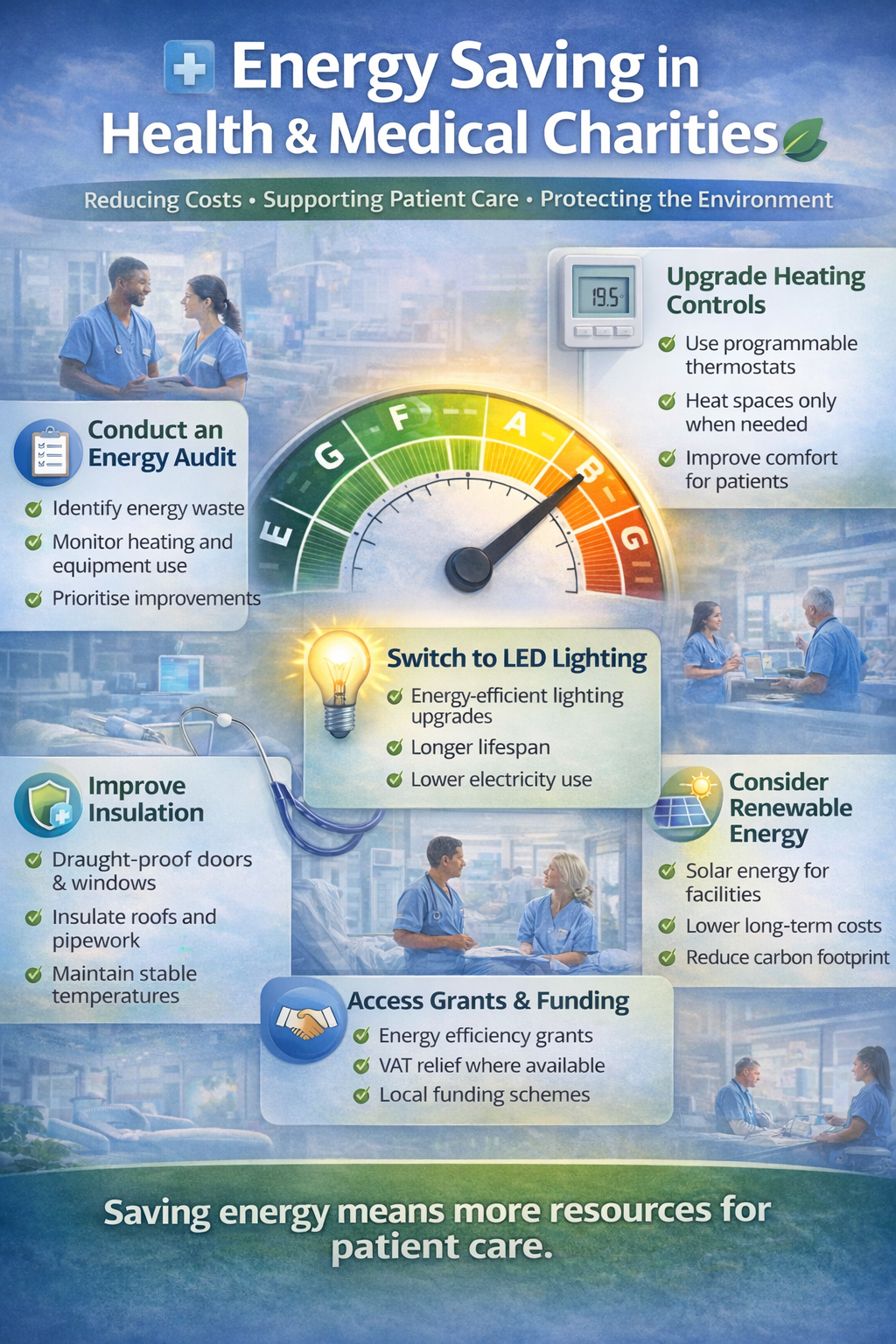
Effective energy management begins with a comprehensive understanding of current consumption. Health and medical charities should commission professional energy audits across their property portfolios to identify inefficiencies and prioritise improvements. These assessments examine building fabric, heating and cooling systems, lighting, equipment, and operational practices. The resulting reports provide roadmaps for action, quantifying potential savings and investment requirements for each recommended measure.
Building management systems offer powerful tools for optimising energy use in complex healthcare facilities. These computerised systems control heating, ventilation, air conditioning, and lighting according to programmed schedules and real-time occupancy data. By ensuring that energy is directed precisely where and when it is needed, building management systems eliminate the waste associated with manual controls and human oversight failures. For continuously operating hospices and care facilities, these systems can adjust environmental conditions based on actual occupancy levels across different zones throughout the day and night.
Heating and cooling represent major energy consumers in healthcare settings. Upgrading to modern high-efficiency boilers and heat pump systems can dramatically reduce consumption compared to ageing equipment. Combined heat and power systems, which generate electricity while capturing waste heat for heating buildings and producing hot water, are particularly effective in facilities with constant thermal demands. Ground-source and air-source heat pumps offer sustainable alternatives that reduce both costs and carbon emissions over their operational lifetimes.
Lighting improvements deliver rapid returns on investment across all facility types. Replacing fluorescent tubes and traditional bulbs with LED alternatives reduces electricity consumption while improving light quality for patients, staff, and researchers. In clinical settings, appropriate lighting supports patient well-being and staff performance, making this upgrade beneficial beyond pure energy savings. Installing occupancy sensors in storage areas, toilets, and intermittently used spaces ensures lights operate only when required, while daylight harvesting systems in offices and public areas automatically dim artificial lighting when natural light is sufficient.
Medical and laboratory equipment continuously consume substantial energy. While clinical requirements must take priority, there are opportunities to improve efficiency. Scheduling equipment start-up times to avoid simultaneous activation reduces peak demand charges. Ultra-low temperature freezers used in research can be consolidated and upgraded to more efficient models. Regular maintenance ensures all equipment operates at optimal efficiency, preventing the gradual performance degradation that increases energy consumption over time.
Renewable Energy and Sustainable Infrastructure
Health and medical charities increasingly embrace renewable energy generation as both a cost-saving measure and a demonstration of environmental commitment. Solar photovoltaic installations on hospital roofs, hospice grounds, and warehouse facilities generate clean electricity, reducing grid dependence and providing long-term cost certainty. Battery storage systems allow solar energy generated during daylight hours to power evening and overnight operations when many healthcare facilities remain fully active.
Some larger health charities have entered power purchase agreements with renewable energy developers, securing clean electricity at favourable fixed rates over extended periods. These arrangements provide budget certainty while supporting the broader transition to sustainable energy systems. For charities unable to install on-site generation, switching to certified renewable energy tariffs ensures that the electricity they purchase comes from sustainable sources.
Engaging Staff and Stakeholders
Sustainable energy management requires engagement at every level of the organisation. Clinical staff, researchers, administrators, and volunteers all influence energy consumption through daily decisions and behaviours. Training programmes that explain the link between energy efficiency and charitable impact help staff understand why conservation matters. Simple guidance on switching off equipment, reporting maintenance issues, and using heating and cooling controls appropriately empowers everyone to contribute.
Regularly communicating energy performance updates maintains visibility and motivation. Celebrating achievements when targets are met reinforces positive behaviours and demonstrates organisational commitment. Some health charities have introduced friendly competition between departments or sites, with recognition for those achieving the greatest efficiency improvements.
Accessing Funding and Support
Numerous funding sources support energy efficiency improvements in charitable healthcare settings. Government schemes, charitable foundations, and corporate giving programmes provide grants for building improvements, equipment upgrades, and renewable energy installations. Professional advisors specialising in charitable energy projects can identify appropriate funding sources and support application processes. The initial investment in professional guidance often yields returns many times greater through successful funding acquisition and optimised improvement strategies.
Conclusion
Health and medical charities carry profound responsibilities for patient welfare and medical advancement. By embracing energy efficiency, these organisations can reduce operational costs, demonstrate environmental leadership, and ultimately direct more resources toward their charitable missions. Through strategic investment in building improvements, equipment upgrades, and renewable energy, combined with engaged staff and appropriate use of available VAT reliefs, health and medical charities can build sustainable operations that serve communities for generations to come.
Health & Medical Charities

Business electricity customers with Half Hourly Power
- Half Hourly Metering - better prices
- UK Manufacturing - better prices
- Larger Energy User - lower energy prices
- Good Credit Co. - better energy prices

Business Sectors
Check Out Other
Business Sectors