
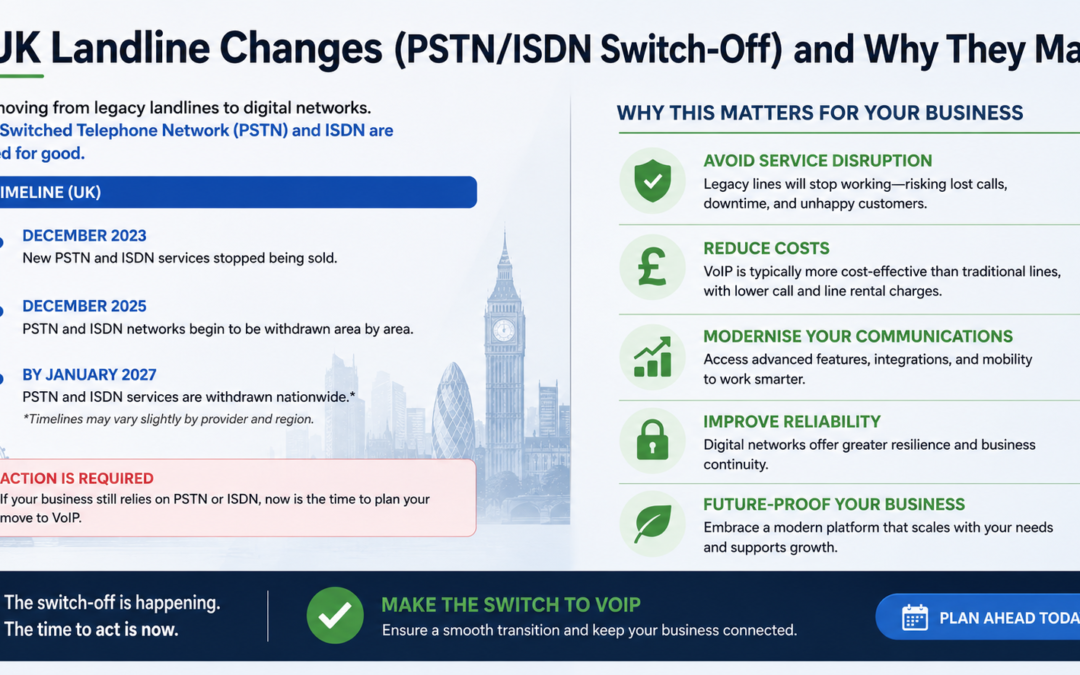
The UK’s traditional landline network—often called the PSTN (Public Switched Telephone Network)—is being retired. ISDN services are also being switched off. The move is industry-led and is happening because the old network is reaching the end of its life and is harder to maintain, while modern services run on digital, internet-based technology.
Government guidance says most customers are expected to have switched by January 2027, with landline services moving to digital voice delivered over an internet connection (for example, VoIP/Digital Voice/All-IP). Providers also need to ensure customers can still contact emergency services, including during a power cut, by implementing appropriate resilience measures where needed.
It’s not just ‘phone lines’—many business devices rely on the old network
One of the biggest risks is that many businesses don’t realise how many of their everyday systems rely on the same legacy lines. Common examples include:
- Phone systems connected to analogue lines, ISDN2, or ISDN30
- Alarm lines (intruder, fire panels, lift phones, emergency call points)
- Payment terminals (EPOS/card machines) and legacy PDQ connectivity
- Door entry and intercom systems
- Remote monitoring, telemetry, and legacy machine-to-machine lines
- Fax machines or anything using a modem tone over a phone line
What changes in practice
With traditional landlines, the phone line itself often carried enough power for basic calling. With digital voice, the call service relies on your on-site equipment (router and VoIP devices) and your internet connection.
That means your business needs to consider power cuts, internet outages, and backup options in a way you might not have before.
Emergency calls: what businesses need to check
For most businesses, emergency calling will continue to work—but it must be planned and tested. Your provider and your internal setup should ensure that calls to 999/112 connect correctly and that any required caller location information is accurate. If your business relies on landlines during a power cut (for example, a reception phone, a care line, or a safety phone), you should also ensure you have a resilience option in place.
How Taurus Utility Consultants can help
The UK’s move away from PSTN/ISDN can catch small businesses out, especially where alarms, door entry systems, or payment services rely on legacy lines. Taurus Utility Consultants can help you understand what’s changing, what it means for your sites, and what to do next. Service delivered by www.TaurusUtilityConsultants.co.uk
- Line and device audit: identify every number, circuit, and “hidden” dependency.
- Risk and resilience planning: power cut considerations, backup routing, and operational continuity.
- Supplier selection and planning: choosing a solution that modernises your office systems without unnecessary cost.
Next step: Speak to Taurus Utility Consultants on 03302237999 or email: info@taurusutilityconsultants.co.uk or visit www.TaurusUtilityConsultants.co.uk for independent advice and supplier selection that suits your needs.
Call to action: protect your business before legacy lines disappear
The changeover to digital voice is not optional—legacy PSTN/ISDN services are being retired, with most customers expected to have moved by January 2027. The biggest problems happen when businesses discover too late that a critical device won’t work on the new setup.
Picture: A BT Broadband Router
- Audit every line and device now—including alarms, lift phones, and payment connectivity.
- Test and plan resilience for power cuts and broadband outages.
- Set a migration timetable that avoids last-minute supplier and installation bottlenecks.
Need a clear plan? Taurus Utility Consultants can review your current services and guide supplier selection—visit www.TaurusUtilityConsultants.co.uk