
Energy Saving in Police Stations
UK police forces manage over 3,000 stations and operational buildings nationwide, with energy costs representing a significant portion of non-payroll expenditure – often exceeding £2 million annually for larger forces. With stretched budgets and increasing pressure to deliver frontline services, reducing energy use is not just about sustainability: it is a practical way to free up resources for community safety initiatives. Police stations face unique challenges, including 24/7 operations, secure environments with strict access controls, and critical systems that cannot be interrupted. Taurus Utilities Consultants has worked with forces across England, Scotland, and Wales to deliver average energy savings of 22%, with one regional force redirecting £180,000 in annual savings toward frontline policing. This 1000-word guide outlines actionable strategies tailored to police station operations, with a UK-specific regulatory and funding context.
Baseline Assessment & Metering – Understanding Your Usage
Accurate data is the foundation of effective energy management, and tailored metering is essential for police stations with diverse operational needs.
Actionable Steps
Implement targeted metering: Install sub-meters for key areas, including custody suites, offices, vehicle bays, and critical systems rooms – not just whole-building meters. For 24/7 operations, half-hourly metering reveals patterns such as unnecessary heating in administrative areas overnight or excessive power use by security lighting during daylight hours. Many forces have leveraged Salix Finance’s interest-free loans to fund upgrades.
Conduct an ESOS-compliant audit: As public sector bodies with significant energy use, most police forces fall under the Energy Savings Opportunity Scheme (ESOS) requirements. Audits should map consumption across all areas, identifying priorities like outdated heating systems or inefficient lighting in high-traffic spaces.
Align with Greening Government Commitments (GGC): The UK government requires public sector organisations to reduce carbon emissions by 50% by 2032. Baseline data from audits and metering provides the framework to track progress against these targets.
Case Study Snippet: A West Midlands police force completed a baseline assessment covering 12 stations. Sub-metering revealed that custody suite ventilation systems were running at full capacity even when cells were unoccupied – a simple control adjustment that delivered £38,000 in annual savings.
Core Area Optimisation – Targeting High-Impact Spaces
Police stations have distinct areas with varying energy demands; optimising these delivers significant savings without compromising operations.
Key Strategies
Custody Suites: These require constant ventilation, lighting, and temperature control.
1. Install occupancy sensors for cell lighting and adjust ventilation rates based on real-time occupancy data – this can reduce energy use in custody areas by up to 30%.
2. Upgrade to energy-efficient LED lighting with motion activation in corridors and holding areas, while ensuring compliance with Home Office security standards.
Offices & Public Areas: Administrative spaces and front desks often operate on variable schedules.
1. Install smart heating controls with zone settings to maintain comfortable temperatures only in occupied areas – for example, reducing heating in offices to 16°C outside of core hours while keeping public reception areas at 18°C.
2. Replace outdated desktop equipment with energy-efficient models and enable power management settings; the Public Sector Decarbonisation Scheme (PSDS) provides funding for such upgrades.
Vehicle Bays & Workshops: These large spaces are often heated and lit inefficiently.
1. Install high-bay LED lighting with daylight sensors and motion controls to reduce use during daylight hours or when bays are empty.
2. Insulate roller shutter doors and upgrade heating systems to high-efficiency models, with controls linked to vehicle movement sensors.
Case Study Snippet: A police station in Newcastle upon Tyne upgraded the lighting and ventilation controls in its custody suite as part of a PSDS-funded project. The work cost £27,000 and delivered annual savings of £12,500 – a payback period of just over 2 years.
Critical Systems Efficiency – Balancing Reliability and Savings
Police stations rely on critical systems, including communications, surveillance, and backup power – these can be made more efficient without compromising performance.
Practical Applications
1. Communications & IT Rooms: These require constant cooling to prevent equipment failure.
Upgrade to variable-speed cooling units that adjust output based on room temperature, rather than running at full load continuously.
Seal cable penetrations and improve insulation to reduce cool air loss, cutting cooling energy use by up to 25%.
2. Backup Power Systems: Diesel generators are essential for resilience, but can be costly to run and maintain.
Test generators only as required by regulations, and use load banks to ensure they operate efficiently when needed.
Consider integrating battery storage systems to reduce reliance on generators during short outages, with funding available through the UK Government’s Energy Innovation Programme.
3. Security Systems: Lighting and surveillance equipment often run 24/7.
◦ Replace traditional security lighting with LED models and use passive infrared (PIR) sensors to activate lights only when movement is detected in perimeter areas.
Upgrade to low-power surveillance cameras that deliver the same image quality while consuming less energy.
Behavioural & Management Strategies – Sustaining Long-Term Savings
Technical upgrades are most effective when supported by engaged staff and clear management processes.
Actionable Initiatives
1. Appoint an Energy Champion: Designate a member of the estates or operations team to oversee energy management, review metering data weekly, and coordinate improvement projects.
2. Train Staff: Deliver targeted training for officers and staff on simple energy-saving actions – such as switching off equipment when not in use, adjusting window blinds to reduce heating/cooling needs, and reporting faulty systems promptly.
3. Set Clear Targets: Use baseline data to establish measurable goals (e.g., 15% reduction in energy use across all stations within 18 months) and share progress with teams to build accountability.
4. Implement a Maintenance Schedule: Regularly service heating, cooling, and lighting systems to ensure they operate at peak efficiency – small issues like dirty filters can increase energy use by 10-15%.
Funding & Compliance – Navigating UK Public Sector Support
There are numerous funding streams and regulatory frameworks to support energy efficiency in police stations.
Key Opportunities
Salix Finance: Offers interest-free loans for public sector organisations to invest in energy efficiency and low-carbon technologies – repayments are made from the savings generated.
Public Sector Decarbonisation Scheme (PSDS): Provides capital grants for projects that reduce carbon emissions, including heating upgrades, LED lighting, and renewable energy integration.
Greening Government Commitments (GGC): Compliance brings access to additional support and resources, while progress is reported publicly to demonstrate transparency and accountability.
ESOS Compliance: Mandatory for large energy users, but the process also identifies cost-saving opportunities that can be implemented with minimal investment.
Conclusion
Saving energy in UK police stations is achievable without compromising operational effectiveness or security. By starting with a robust baseline assessment, optimising core areas, improving the efficiency of critical systems, and embedding strong management practices, forces can deliver significant cost reductions that directly benefit frontline services. With access to dedicated public sector funding and clear regulatory frameworks, there has never been a better time to invest in energy efficiency.
Taurus Utilities Consultants works with police forces to tailor solutions to their unique needs, ensuring every pound saved is redirected toward keeping communities safe.
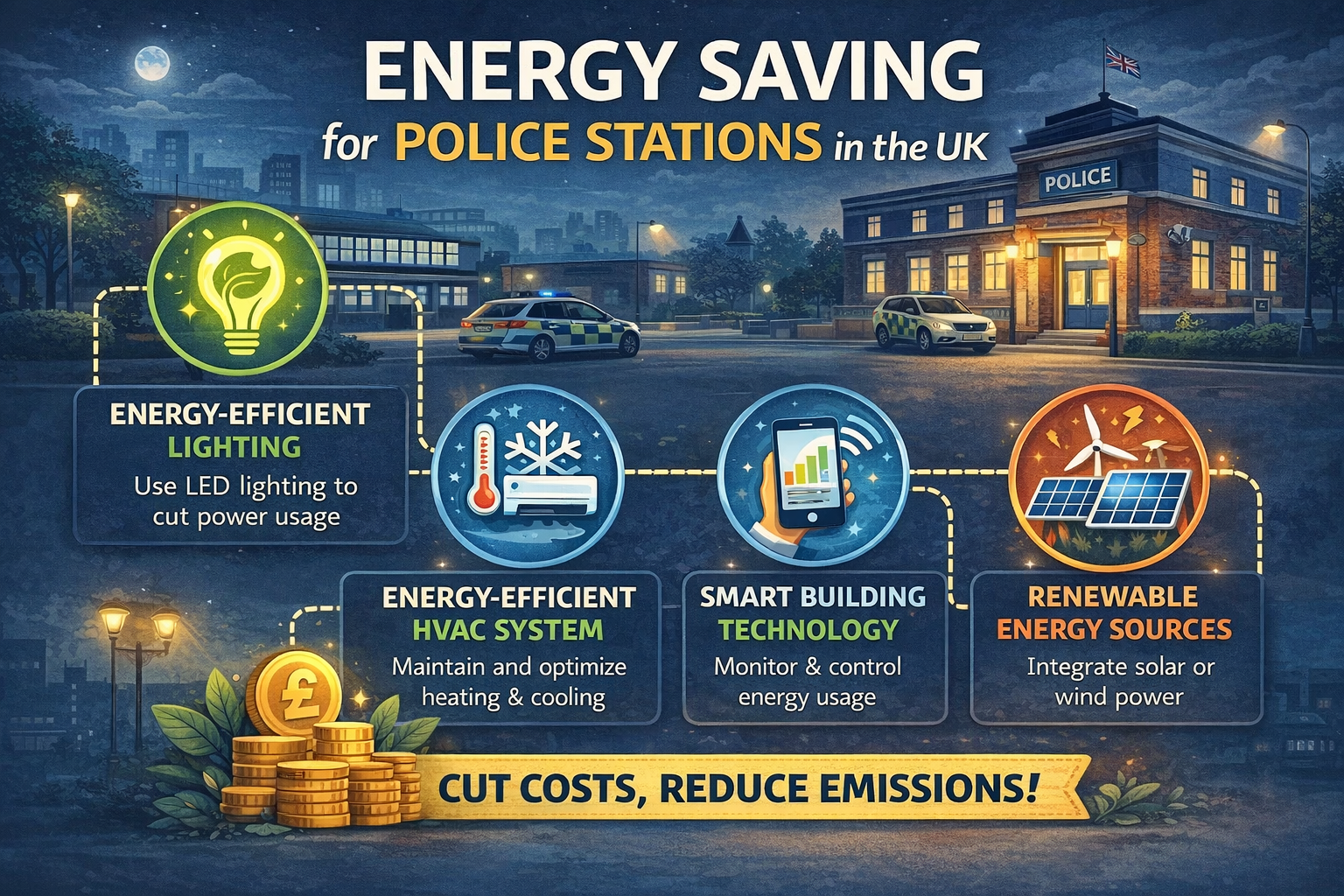
Energy Saving in Police Stations

Business electricity customers with Half Hourly Power
- Half Hourly Metering - better prices
- UK Manufacturing - better prices
- Larger Energy User - lower energy prices
- Good Credit Co. - better energy prices

Business Sectors
Check Out Other
Business Sectors